
NYC Launches ECB Amnesty and Compliance Program | Volume 11, Issue 9
Photo by onas mer
New York City recently opened a 90-day amnesty window that could wipe out years of interest and penalties on your unpaid city fines. The Debt Demolisher Program runs through January 10, 2027 and when it's gone, your balance goes right back to full price.
The program applies to eligible judgments arising from violations issued by various New York City agencies, including the Department of Buildings, Department of Environmental Protection, Fire Department, Department of Sanitation, and Department of Transportation.
What you could save:
Missed your hearing? Pay just the original base fine — every dollar of default penalties and accrued interest is waived.
Found liable after a hearing? Pay only 75% of the fine, with all interest waived.
Already paid part of a fine? You may be able to settle the remaining balance for as little as $1.
Each judgment must be paid in full (no payment plans), violations that require repairs need a certificate of correction approved before the deadline, and some judgments don't qualify at all — including anything docketed after July 15, 2026, citizen-complaint violations like idling and noise, and debts already converted to tax liens. Miss a step and you lose the discount.
How we can help:
Let us review your violations, confirm which ones qualify, handle the certificates of correction and paperwork, and make sure every eligible judgment is settled before the January 10 deadline — so that you don't leave money on the table or get stuck paying full price in February.
This window closes January 10, 2027, and it won't come back. Contact Kevin Danielson, Esq. today for a review of your ECB judgments: (917) 512-1113.
NYC Property Owners: December 31st Deadline Approaching | Volume 11, Issue 8
Photo by Jailyn Funn
If your building has a parapet facing a public right-of-way, December 31st is an important compliance deadline.
New York City requires buildings to have their parapets observed annually. With the deadline approaching, property owners and managers should be confirming that the required observation has been addressed for their properties.
This is not a deadline to overlook.
A missed or delayed observation can lead to additional compliance issues, particularly if an unsafe condition is identified and corrective action is required.
If you manage or own NYC properties, now is the time to make sure your parapet observation requirements are taken care of before December 31st.
Not sure whether your property is subject to the requirement or what needs to be addressed?
RPO can help!
Contact RPO to discuss your property’s parapet observation requirements and make sure you are prepared before the deadline.
RPO CLIENT ADVISORY: DOB Invalidates Redcode Inc. Site Safety Training Certificates | Volume 11, Issue 7

Photo by Doctor Casino
What Happened
On September 8, 2026, the Brooklyn District Attorney’s Office indicted Redcode Inc. for fraudulently issuing Site Safety Training (SST) certificates. In response, the Department of Buildings is immediately invalidating all SST certificates issued by Redcode Inc.
This isn’t an isolated incident – Brooklyn’s DA has brought similar cases against fraudulent safety-training providers in recent years, underscoring how seriously the city treats fake certification schemes tied to construction site safety.
Who Is Affected
Workers holding an SST card issued directly by Redcode Inc.
Workers holding an SST card issued by another registered course provider that relied on Redcode-issued OSHA certificates.
Key Dates and Requirements
Now through December 7, 2026: 90-day grace period is in effect. Affected SST cards will remain active when scanned on job sites during this window, giving workers time to complete replacement training.
December 7, 2026: Deadline for affected workers to obtain a new SST card through a DOB-registered course provider.
December 8, 2026 (and after): Any Redcode-issued SST card not replaced will be revoked. SST cards issued by other providers using Redcode OSHA certificates will also be revoked unless the required retraining was completed.
DOB is also no longer accepting OSHA cards issued by instructor SM Lutfur Rahman, owner of Redcode Inc., toward SST requirements. Affected workers must complete OSHA training through a current, DOB-approved OSHA training provider.
What Property and Construction Managers Should Do
Audit your workforce and subcontractor rosters for SST cards issued by Redcode Inc. or tied to Redcode-sourced OSHA certifications
Flag any affected workers now, rather than waiting for the December deadline – registered course providers may see a surge in demand as the grace period closes
Confirm replacement certifications are logged before December 7, 2026, to avoid site access issues or DOB compliance flags
Loop in your safety monitors and site superintendents so scans at the gate aren’t a surprise mid-project.
Questions?
RPO is available to help clients assess exposure and coordinate replacement training logistics ahead of the deadline.
NYC DOT Adopts New Highway Rules: Increased Penalties and New Compliance Requirements | Volume 11, Issue 6

Photo by Christian M. M. Brady
New York City Department of Transportation recently adopted various amendments to Chapter 2 of the New York City Highway Rules. These changes primarily clarified existing requirements/practices, introduced several new infractions to the penalty schedule and significantly increased the fines for a number of existing violations. The amendments go into effect on September 24, 2026.
Several new penalty provisions have been added to the DOT civil penalty schedule. Of note are the following:
Failure to take corrective action within three hours of a Priority Corrective Action Request
Failure to restore a street opening or excavation in accordance with DOT protected-street restoration requirements
Placement of a storage box or CONEX box on a city street without DOT authorization
These new infractions are in addition to changes that clarify and expand existing DOT requirements.
Additionally, the newly adopted rules substantially and dramatically increase the penalties for several existing violations with the most minimal increase being double the current fine amount. In some cases the increases are even more dramatic. For example, the penalty for having a construction shanty or trailer without a DOT permit raised from $150 to $1,200. The corresponding default fines can be substantially higher, in some instances ranging from $3,600 to $15,000.
RPO Inc. answers violations on behalf of clients and has an extensive and proven track record of having fines reduced or the violations outright dismissed at hearings. We take pride in putting in the requisite time required to thoroughly review each violation and have the advantage of being able to consult with our project management/code research staff so as to enhance our chances of achieving the optimal outcomes for our clients. With fine amounts constantly increasing, the need for exemplary representation is paramount.
If you would like RPO to review violations issued to your property or project, or represent you at hearings, please contact Kevin Danielson, Esq: (917) 512-1113.
NYC Department of Transportation Rule Revisions | Volume 11, Issue 5
Photo by Eric Konon
RPO would like to make you aware of significant changes to DOT Regulations.
1. New General Compliance Requirement has been added that comes replete with its own new corresponding violation:
Applicants, permittees, and persons conducting business with the DOT must comply with:
The Highway Rules
Standard Specifications
Standard Drawing Details
All other applicable laws and rules
A separate violation can be levied for each offense and for each day that the violation continues.
It is more important now than ever before to understand the requirements of your permits; RPO is prepared to consult about permits that we obtain for our clients.
2. Expanded Flagger Requirements
The rule requires flag people when there is active work such as:
Closing a moving traffic lane and/or bicycle lane; and
When traffic is temporarily diverted
The permittee must also provide and adhere to an authorized Maintenance and Protection of Traffic plan.
RPO provides consulting services and advocates on behalf of clients utilizing its permit services. Our staff is uniquely equipped to assist clients in understanding DOT requirements and creating compliant MPT plans.
3. Winter Moratorium Requirements
During the winter moratorium, permittees/entities with plating or decking must post appropriate signage, including:
“Plates Ahead” or “Raise Plow”
The plates must also be countersunk flush with the roadway. Signs must be placed five (5) feet before the plates and, on two-way streets, on both sides of the street.
4. Emergency Work
Emergency work has been narrowed and clarified. Emergency work is work necessary to:
Rectify a condition endangering public safety; or
Address a situation causing, or likely to cause, an imminent interruption of service required by law, contract, or franchise to be continuously maintained.
Emergency work is not applicable to:
New construction
Regrades of existing hardware
Work that is not necessary to address imminent interruption
You cannot get a permit for “Emergency Work” unless it meets the correct standard.
5. CONEX Boxes Explicitly Prohibited
Placement of a CONEX storage boxes on any City street is now expressly prohibited unless authorized by the Commissioner.
6. Violation Adjustments
Increase in violation amount and new types of violations have been established. RPO’s violation experts are putting together a separate newsletter that details these changes specifically. The changes are significant, so look out for details from us shortly.
Bottom Line
This new DOT rule should be viewed as a meaningful operational and compliance update for NYC street-construction activity. The biggest changes are not simply paperwork requirements. The rule creates clearer boundaries around when work can occur, how roadway conditions must be maintained, what must happen before and after embargo periods, who is responsible for defects, how emergency work is defined, what materials can be stored on City streets, and the financial consequences of noncompliance.
If you need assistance or have any questions regarding how to incorporate these new rules in your projects, contact RPO for assistance.
Volume 11, Issue 4: No Dig Special Construction Embargo (7/2/2026 – 7/6/2026) – What You Need To Know
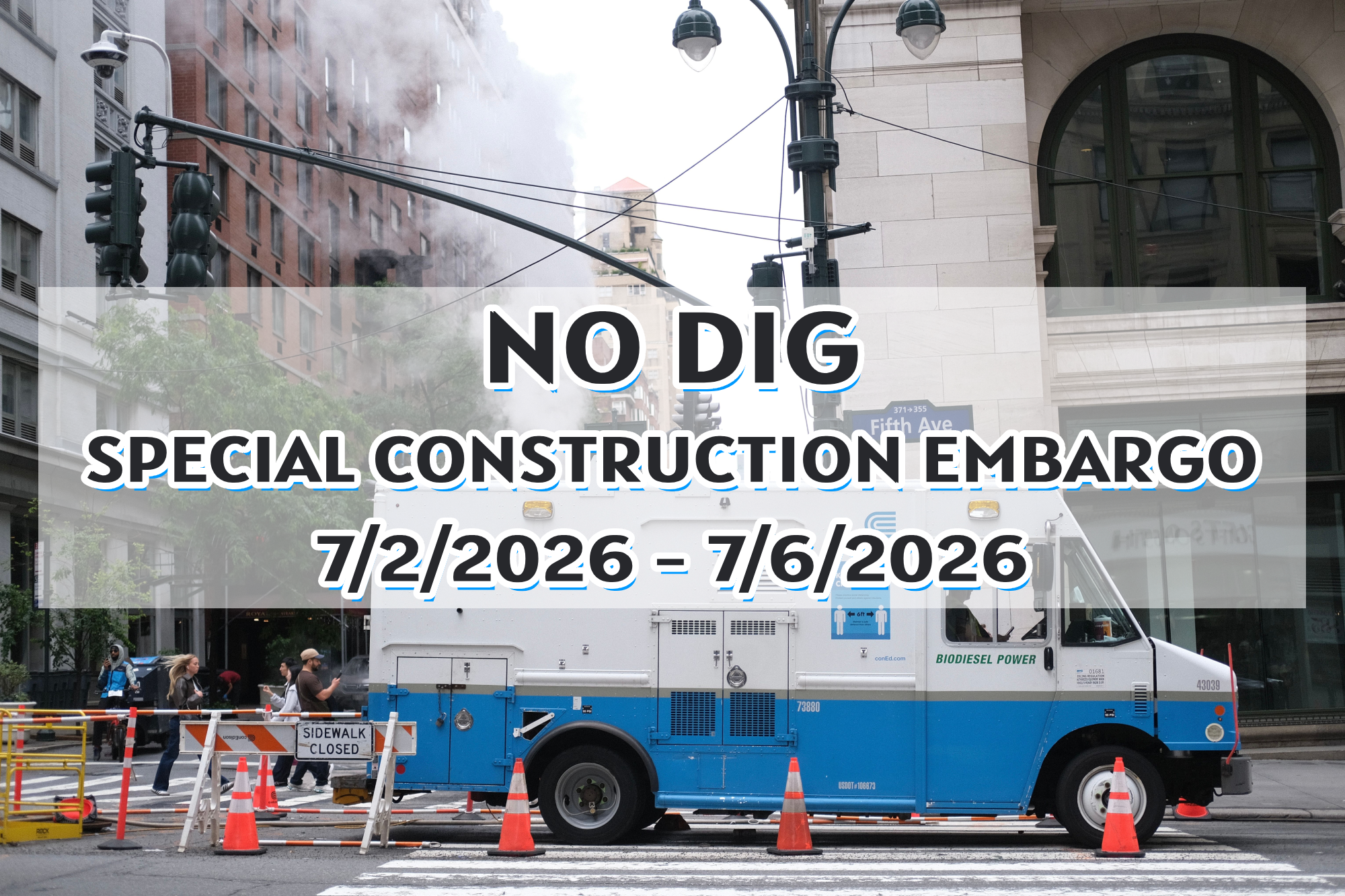
Photo by Burcu Elmas
Here’s the situation. At Con Edison’s request, a special construction embargo has been issued for the entire NYC area. It’s effective immediately and runs through Monday, July 6, 2026.
What this means for your job sites:
Non-emergency street excavation permits are suspended, even ones issued before this notice
Utility cover openings are restricted unless you have an emergency authorization number from DOT
Only emergency work is allowed, and it requires an emergency number from NYC DOT
Enforcement is strict. Violators will be summonsed
What you should do right now:
Check any active or upcoming excavation permits against this window. If you have non-emergency work scheduled between now and July 6, it’s suspended. Don’t risk a summons.
If you believe your work qualifies as emergency work, you’ll need to secure an authorization number from DOT before proceeding.
If you have questions about how this affects a specific site, reach out to RPO.
Volume 11, Issue 3: Adoption of the 2025 NYC Energy Conservation Code

Photo by @lifeforstock
The 2025 New York City Energy Conservation Code (NYCECC) has been adopted but will not be enforced until approximately March 30, 2026. This is due to updated compliance software not being readily available to the public just yet. In the meantime, the Department of Buildings will continue to enforce the 2020 NYCECC. Any change to the anticipated enforcement date will be communicated by the Department through a Service Update.
How it will affect New and Prior Projects:
New Projects – submitted on or after March 30, 2026, must comply with the 2025 NYCECC.
Prior Projects - filed before March 30, 2026, must comply with 2020 NYCECC.
Incomplete Filings – submitted before March 30, 2026, with incomplete energy analysis or that undergo a material compliance change after March 30, 2026, must comply with 2025 NYCECC.
Volume 11, Issue 2: Update on DOB NOW's document upload and download functionality

Photo by @wirestock
As many of you may know, DOB NOW was having issues with their document upload and download functionality. The DOB has released a statement today (January 16, 2026) regarding the issue.
“Document upload and download functionality has been restored. Please be advised that documents uploaded between January 12, 2026 and January 15, 2026 are temporarily unavailable. We are actively working to restore access quickly as possible. We appreciate your patience and will share updates as they become available.”
RPO is monitoring client projects that were affected by this outage and will resume its work once functionality is restored.
Volume 11, Issue 1: 2026 Updated Fee Calculations for Subsequent Filings in DOB NOW: Build

Photo by rawpixel-com
Beginning January 26, 2026, Alt-CO – New Buildings with Existing Elements to Remain, new Full Demolition filings, and AHV Permits will have updated fee calculations for subsequent filings in DOB NOW: Build.
Alt-CO – New Buildings with Existing Elements to Remain & New Alteration Jobs in Conjunction with an Alt-CO
Rather than the $130 flat fee, subsequent filing fees will be calculated based on the construction cost reported on the filing.
1, 2, or 3-Family = $170 (for the first $5,000) + $2.60 (per each $1,000 above $5,000)
Buildings Below 7 Floors = $280 (for the first $3,000) + $10.30 (per each $1,000 above $3,000)
Building 7 Floors or Above = $290 (for the first $3,000) + $17.75 (per each $1,000 above $3,000)
This will only apply to the following work types for Alt-Co – New Buildings with Existing Elements to Remain:
Plumbing, Sprinkler, Standpipe, General Construction, Mechanical Systems, Structural, Support of Excavation, Protection and Mechanical
Full Demolition
A “Record Management” fee will be charged for initial filings submitted on or after the launch date according to the building type:
1, 2, or 3-Family = $45
Other = $165
After Hours Variance (AHV) Permit Fees
Filings that are fee-exempt (other than government-owned properties) will now be charged a standard fee for AHV’s.
Volume 10, Issue 10: 2026 Changes for Construction Superintendent Per Local Law 149 of 2021

Photo by Freepik
Beginning January 1, 2026, the DOB will begin enforcing new Construction Superintendent limitations in relation to Local Law 149 of 2021. This law has been reducing the number of construction projects a registered superintendent can be associated with. Beginning January 1, 2026, a CS may be designated for only one (1) building project – either major or non-major.
If you are designated as CS for up to three non-major building jobs as of December 31, 2025, you may continue with those jobs after January 1, 2026, but you may not be designated as the primary for additional jobs until the preexisting jobs are completed or the CS has been removed. If you leave a project, you may not replace it with another project.
This allowance to hold multiple jobs will end on January 1, 2027, which means if any CS is holding multiple non-major building jobs from December 31, 2025, will have to drop all jobs except one (1).
For both major and non-major building jobs, the CS can continue designating a Competent Person until December 31, 2026. This will end on January 1, 2027, and starting then, a CS will be required to be at the site during all times of work, except for the exempted activities listed in the building code.
Subject to Department approval, a CS may serve as the primary for multiple non-major building jobs on the same lot or contiguous lots.
Volume 10, Issue 9: Building Energy Efficiency Rating Label Deadline
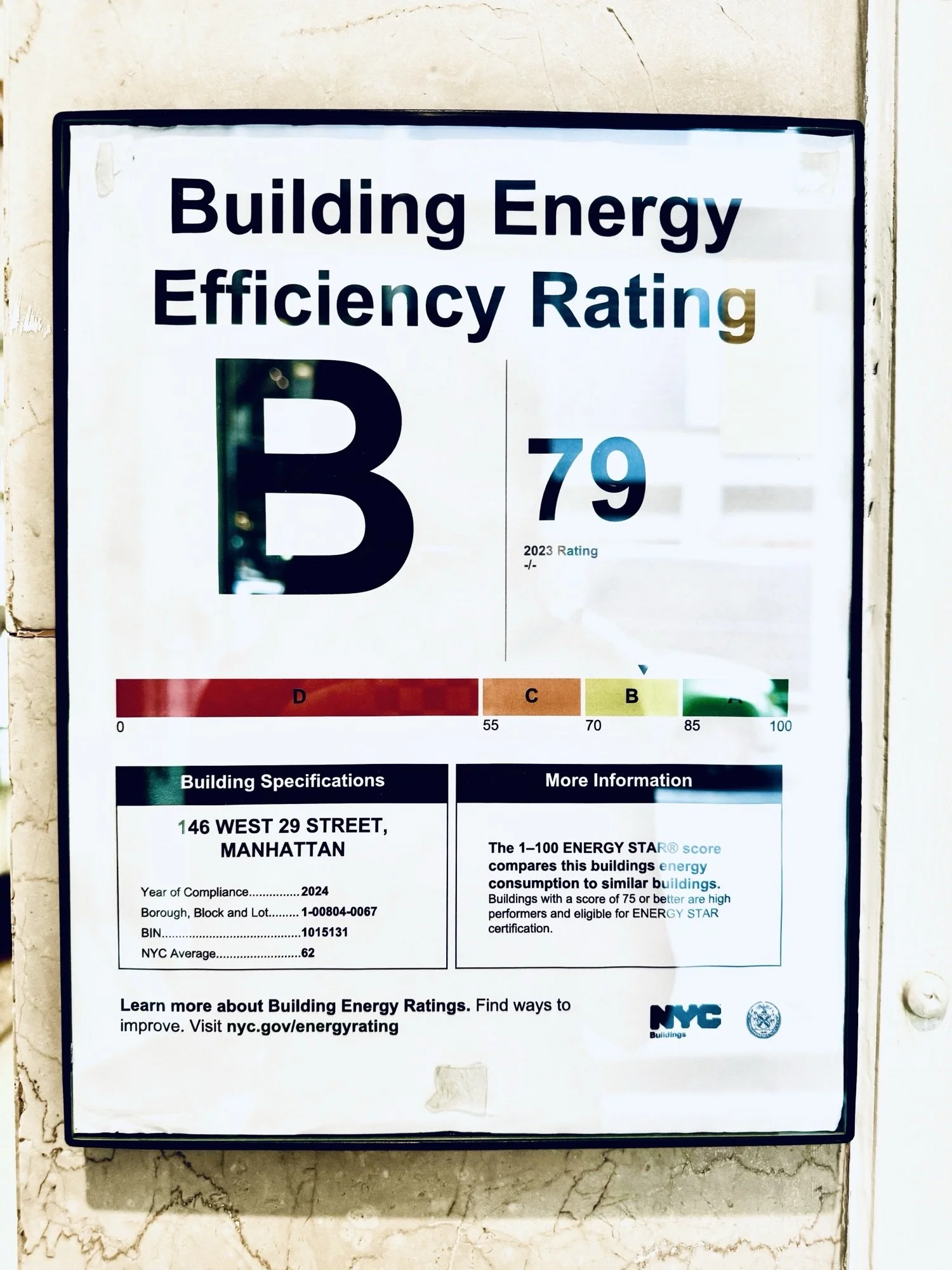
If your building appears on the NYC Benchmarking Covered Buildings List for Compliance in 2025 and is over 25,000 square feet or multiple buildings on a lot totaling 100,000+ square feet, you must post the Building Energy Efficiency Rating Label no later than December 31, 2025.
As required in Local Law 22 of 2018 and Local Law 95 of 2019, your label MUST include the Energy Efficiency Score of the building, an Energy Efficiency Rating of A-F, and the buildings 2024 energy efficiency grade and is located in a conspicuous location near each public entrance. Failure to post the label may result in a civil penalty of $1,250.
If you need help with accessing and printing your Building Energy Efficiency Label, please contact RPO for assistance.
Volume 10, Issue 8: NYC Parking Structure Inspection Requirements

Photo by conceptphoto.info
If you own a parking structure in Sub-cycle B (Manhattan Community Districts 8–12 and all Brooklyn Community Districts), please note that the deadline to comply with New York City’s Parking Structure Inspection requirements is December 31, 2025 — just around the corner.
For those in Sub-cycle C (Bronx, Queens, and Staten Island), now is a great time to begin preparing for your upcoming inspection cycle, which runs from January 1, 2026 through December 31, 2027.
Reminder:
To maintain safety, all NYC parking structures must be inspected by a licensed Professional Engineer (PE) who is also a Qualified Parking Structure Inspector (QPSI) at least once every six (6) years.
If any unsafe conditions are found, repairs must be completed within 90 days of filing the condition assessment report. Once repairs are finished, an amended report must be submitted within two (2) weeks.
If you need help scheduling an inspection or would like to engage RPO to file your inspection report, please contact our office for assistance.
Volume 10, Issue 7: NYC Ballot Proposal 5 Opinion

Photo by archives.nyc
There are six proposals on the ballot for the upcoming election. Proposal 5 would consolidate the official City Map, which plays a little-known but critical role in the approval of housing and infrastructure projects, into a single map and digitize it. Additionally, it would make the Department of City Planning (DCP) responsible for creating, maintaining and digitizing a single city map. Today, the City Map consists of five different sets of maps, one for each borough.
The City Map is the official registry of streets and publicly owned land as it legally defines street names, assigns addresses for new buildings, maintains street information, and provides crucial data on what lies beneath Manhattan’s buildings, basements, and tunnels. Currently, the City Map is managed by five Topographical Bureaus located in each Borough and consists of more than 8,000 maps in total.
Proponents of this proposal tout the measure as a way to streamline and expedite processes that depend on city maps, such as infrastructure and housing projects. Additionally, supporters feel this proposal would make public information more readily available and the digital nature would make this easier to access, especially to New Yorkers with disabilities.
While the above advantages may be appealing, it is our experience that Topographical Bureau workers possess experience and expertise that is crucial to dispense accurate information - some of which is highly technical in nature - to residents and professionals alike. Outsourcing these duties to a centralized agency with workers who are not necessarily equipped to handle this type of responsibility could have negative repercussions and may result in a severe back-log or worse yet, may result in the incorrect transcription of information. This is especially important given that several agencies such as the Department of Buildings, New York Fire Department and others rely on this information for their own record keeping. This type of work requires strong communications skills and in-person interaction to effectively and accurately manage this important information.
Over the past years citizens have suffered through numerous examples where “streamlining” via difficult-to-use technology has usurped the role of civil servants in aiding residents with the successful fulfilment of City requirements. Proposal 5 would only serve to change a system that has been working quite well for over 100 years.
Kevin Danielson is an attorney and consultant with RPO Inc. He represents clients on a variety of matters involving compliance with City regulations.
A PERSONAL MESSAGE FROM MICHAEL PRESSEL

On a personal note, my wife has decided to change ambitions and end her 20+ year career of owning the award winning Inn at Glencairn Bed and Breakfast in Princeton, NJ.
The 18th century home with outbuildings is now for sale, so if you know anyone who is interested in living in a historic home or running a bed and breakfast please forward the following link to them:
Inn At Gleincairn
The Inn has been a temporary home to a number of dignitaries and celebrities over the years who were visiting area prep schools such as The Lawrenceville School, The Pennington School, Hun, Princeton Day School or who were performing and filming at Princeton University. It has also been the location for numerous, memorable RPO Outings. Please reach out if you have any questions.
Michael Pressel
President


Volume 10, Issue 6: NYC Establishes New Energy Storage Rules
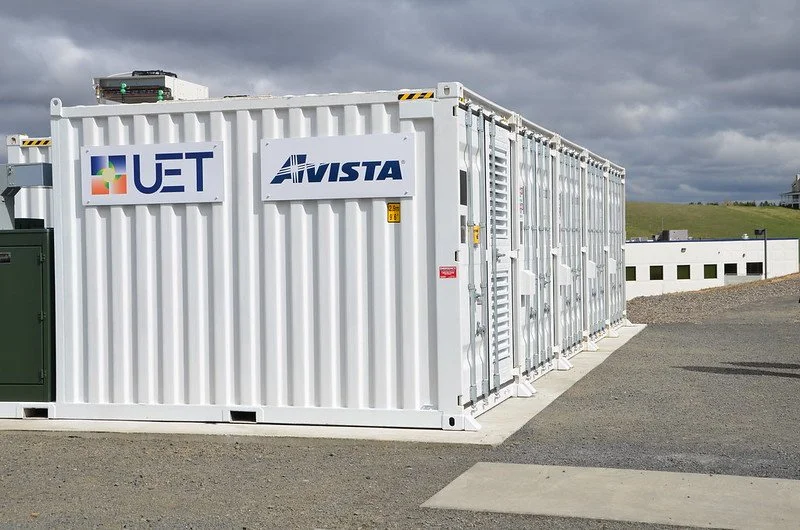
Photo by Governor Bob Ferguson
New York City’s Department of Buildings issued notice on September 17, 2025 that it adopted two new rules on stationary electrical energy storage systems (ESS). These rules take effect on October 26, 2025. ESS, which can be inside and on top of New York City buildings, should be designed, installed, operated, and monitored in ways that ensure the systems’ safety. The Department thus promulgated the rules to set safety criteria standards.
ESS collect and set aside energy that can supply electricity at a later time depending on the demand and provide several benefits:
They supply backup power to the electrical grid for outages, making the grid more reliable.
They improve renewable energy sources’ dependability, storing renewables’ excess energy during periods of low demand.
They reduce New Yorkers’ energy costs, storing excess energy when energy costs are cheaper during off-peak times and releasing the energy during peak periods.
The aforementioned rules mandate the following:
Clarifies design, filing, construction, installation, commissioning, operation, maintenance, and decommissioning of specified indoor and outdoor ESS.
Establishes reporting requirements.
Requires construction applications be filed with DOB.
Mandates that permits must be acquired for both construction and electrical work before ESS projects begin.
Requires registration with the Department:
New ESS: owners/managers must register before operation.
Existing ESS: must be registered within three years of rule’s effective date
Modifies NFPA 855 (national standard for ESS installation) to address New York City’s unique urban environment.
Expanded scope applies to:
Indoor stationary ESS
Mobile/portable ESS installed in stationary settings
Storage of lithium metal and lithium-ion batteries
Please contact RPO with any questions related to these new changes.
Volume 10 | Issue 5: New Local Law Significantly Changes Requirements for Sidewalk Sheds

Photo by Kathleen
Local Law 47 of 2025 is now in effect and mandates some critical changes as it pertains to sidewalk sheds:
New sidewalk sheds filed on/after August 15, 2025 must have a minimum clear ceiling height of 12 feet which is a significant increase from the previous required minimum height of 8 feet.
Sheds filed prior to August 15, 2025 are not required to be modified to this new standard.
Lighting and certain bracing are excluded from the height measurement, provided code requirements are met.
If the 12-foot ceiling height interferes with required air, light or egress for building occupants, the height may be reduced to between 8 and 12 feet provided there is proper documentation from the Registered Design Professional.
Additionally, minimum illumination under sidewalk sheds has been increased to 1.5 foot-candle and if the walking surface is within 10 feet of a subway entrance, bus shelter or similar facility, the minimum requirement is 5 foot-candle.
Finally, acceptable colors for sidewalk sheds now include hunter green, metallic gray or white. However, sheds must be uniform in color with exceptions for metallic elements and parapet mesh and sheds and fences at the same site must match in color.
Please contact RPO with any questions related to these new changes.
Volume 10 | Issue 4: Stricter Enforcement Measure Enacted for Facade Repairs

Photo by LeoSynapse on Freeimages
A new local law, LL 51 of 2025, is now in effect which significantly changes the allowable timeline for façade repairs. Upon issuance of a sidewalk shed permit, the following deadlines apply:
Construction documents must be filed within 5 months
DOB permit applications must be filed within 8 months
Repair program must be completed within 2 years
Failure to meet any of these deadlines will result in violations and fines ranging from $5,000 to $20,000.
The only exceptions to this local law apply to sidewalk sheds installed in conjunction with permitted new building, enlargement or demolition work.
Extension may be granted if submitted in advance and approved by the Department of Buildings.
Volume 10 | Issue 3: 2025 NYC Electrical Code: Electrical Jobs Filed in BIS

Image by Michal Jarmoluk from Pixabay
Effective August 23, 2025, all electrical jobs filed in the Buildings Information System (BIS) that have not been signed off by the Department of Buildings (DOB) will be marked as Abandoned in BIS.
To complete and sign off on an Abandoned BIS job, you must reinstate it in DOB NOW: Build.
If you have any electrical applications ready for sign-off, we recommend starting the process now to avoid additional steps or potential issues in DOB NOW due to upcoming system changes.
For more info refer to Buildings Bulletin 2024-008 for guidance on when to apply the 2025 NYC Electrical Code vs. the 2011 edition.
Volume 10 | Issue 2: Increased Penalties In Effect for Retaining Wall Rules

Image from Meg
Several amendments to the New York City Department of Buildings rules (1 RCNY 103-09) pertaining to retain wall inspections are now in effect. Most noteworthy are increased penalties for non-compliance:
• Failure to file an acceptable report: Increases from $1,000 per year to $5,000 per year.
• Late filing of a report: Increases from $250 per month to $1,000 per month.
• New penalty for failure to correct SREM (safe with repairs and/or engineering monitoring) conditions: $2,000.
Additionally, in effect are amendments related to retaining wall inspections, filing requirements and waivers. These details can be found here.
Please contact RPO with any questions related to these new rules.
Volume 10 | Issue 1: Benchmarking Compliance Deadline Extension

Image from prostooleh
The NYC Department of Buildings has extended the deadline for submitting 2024 Benchmarking reports. Property owners now have until June 30, 2025, to file their annual Energy and Water Use date without facing violations or penalties.
This extension comes in response to the launch of the new LL97 Reporting Portal on March 3, 2025, which changed the submission process for compliance with Local Law 97 (LL97) and Administrative Code §28-309.4.
Key Updates:
New Benchmarking Deadline: June 30, 2025
LL97 Deadline Extension: Owners subject to LL97 may request an extension to August 29, 2025, via the portal (filing fee required). If granted, this also extends the Benchmarking deadline to August 29, 2025.
If you need assistance complying with the new submission process, please contact RPO Inc.